
Lake County Projected Versus Actual
A projected date is calculated from the sentence and facts known at that time. An actual release date records what happened. IDOC’s public profile uses the label “Projected Parole Date.” Its internal docket and release card uses “Projected minimum/release date” and “Projected maximum/mandatory outdate.” Staff must maintain those changeable fields, so none should be renamed as a final gate date.
A pretrial Lake County detainee does not have a sentence-based out-date. Release depends on a court order, bond or pretrial conditions, dismissal, transfer, or another lawful event. A sentenced county-jail inmate has a defined judgment, but the release still depends on custody credit, other cases, warrants, detainers, and the Sheriff’s final transaction. An IDOC prisoner follows state computation rules instead.
Physical release and final discharge may also differ. A person can leave prison on parole or mandatory supervised release while IDOC legal custody continues. The projected discharge date points toward the end of that later term, not the day prison housing ended.
Find Lake County Projected Release Dates
Begin with custody class. The Sheriff’s current portal cannot calculate an IDOC prison term, and IDOC arithmetic does not control a county-jail-only sentence. Lake County also holds some people under federal contracts and may house detainees temporarily in McHenry County. Physical location alone therefore does not identify the agency that computes the date.
- Identify the sentence and custodian. Use the judgment, commitment order, or current custody record.
- For IDOC, search the official profile. Use an IDOC number when known, or search by partial last name or date of birth.
- Read the exact field. Record “Projected Parole Date,” status, institution, offense, and sentence details without calling the date actual.
- For a Lake County sentence, obtain the court papers. Request the mittimus, judgment, presentence credit order, and any amended order from the Circuit Clerk.
- Ask for the custody transaction. The Sheriff’s record supplies the actual release or transfer date and disposition.
- Recheck after the date. Look for a changed profile, a release event, parole/MSR status, or transfer to another authority.
The IDOC Individual in Custody Search covers state prison and people still displayed on parole. Search by IDOC number, partial surname, or date of birth, then compare identity and sentence facts. The official search entry shows the state route used for this stage:
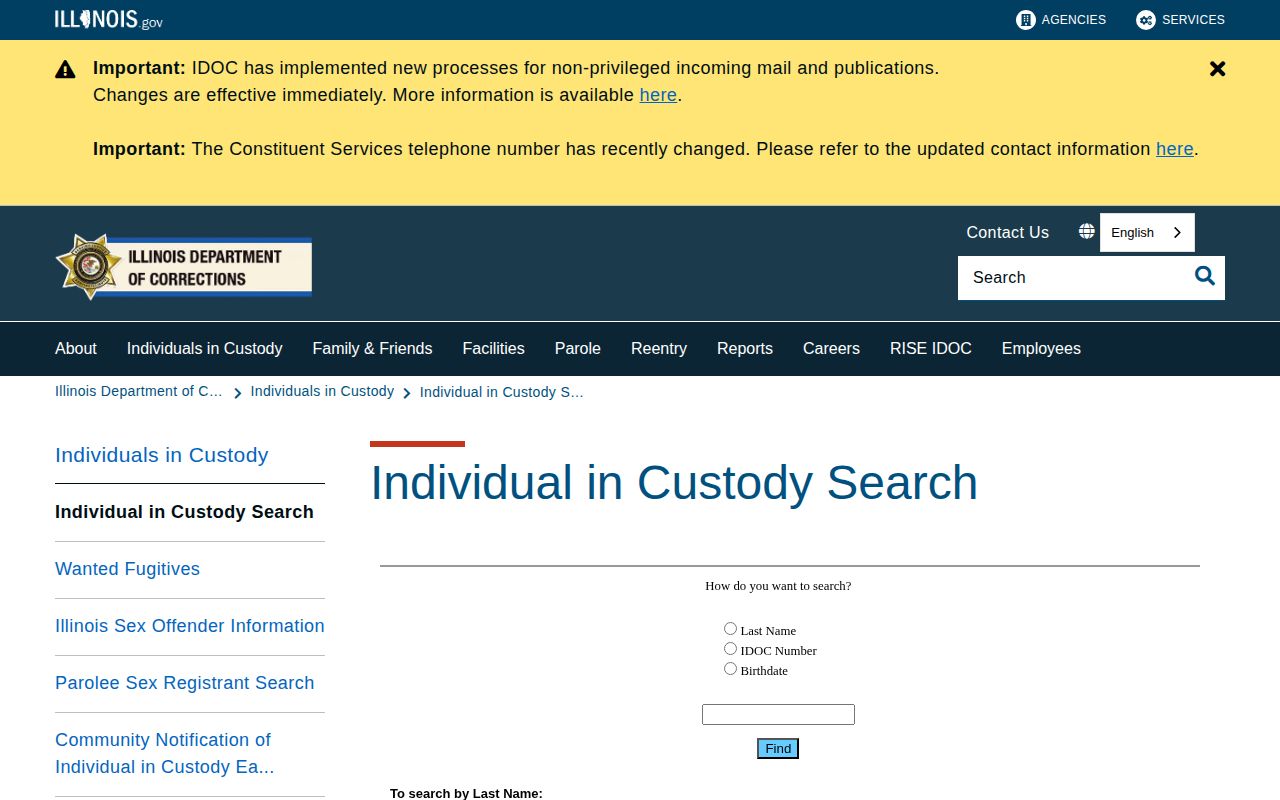
The state result must still be tied to the correct person and its projected field label.
For county-only custody, use the Lake County Circuit Clerk document request and Sheriff records. The Lake County release-record workflow lists the booking and custody fields to request. Do not estimate an out-date from the sentence length alone.
Note: A transfer from Lake County jail to IDOC ends the county hold but is not a community release.
Illinois Credit and Release Dates
Illinois has no universal rule that every prisoner serves 85 percent. Under 730 ILCS 5/3-6-3, service fractions can be 50, 75, 85, or 100 percent depending on the offense, offense date, and statutory category. The law contains exclusions and special limits. “Eighty-five percent” is accurate only for specified offenses.
IDOC separates statutory sentence credit, program sentence credit, and discretionary Earned Sentence Credit. Its FAQ describes program credit in general as one-half day for each successfully completed eligible program day. Many people in 85-percent or 100-percent categories are ineligible. Earned Sentence Credit can be up to 180 days under statutory and individual criteria, but eligibility does not guarantee an award.
The calculation also needs the judgment, offense and offense date, sentence length, presentence custody credit, concurrent or consecutive structure, awarded and lost credits, discipline, detainers, and later court or agency changes. IDOC says a credit award that changes the projected parole date is reflected in the public profile and communicated to the person.
The statute screenshot provides the governing Illinois source for sentence-credit categories:
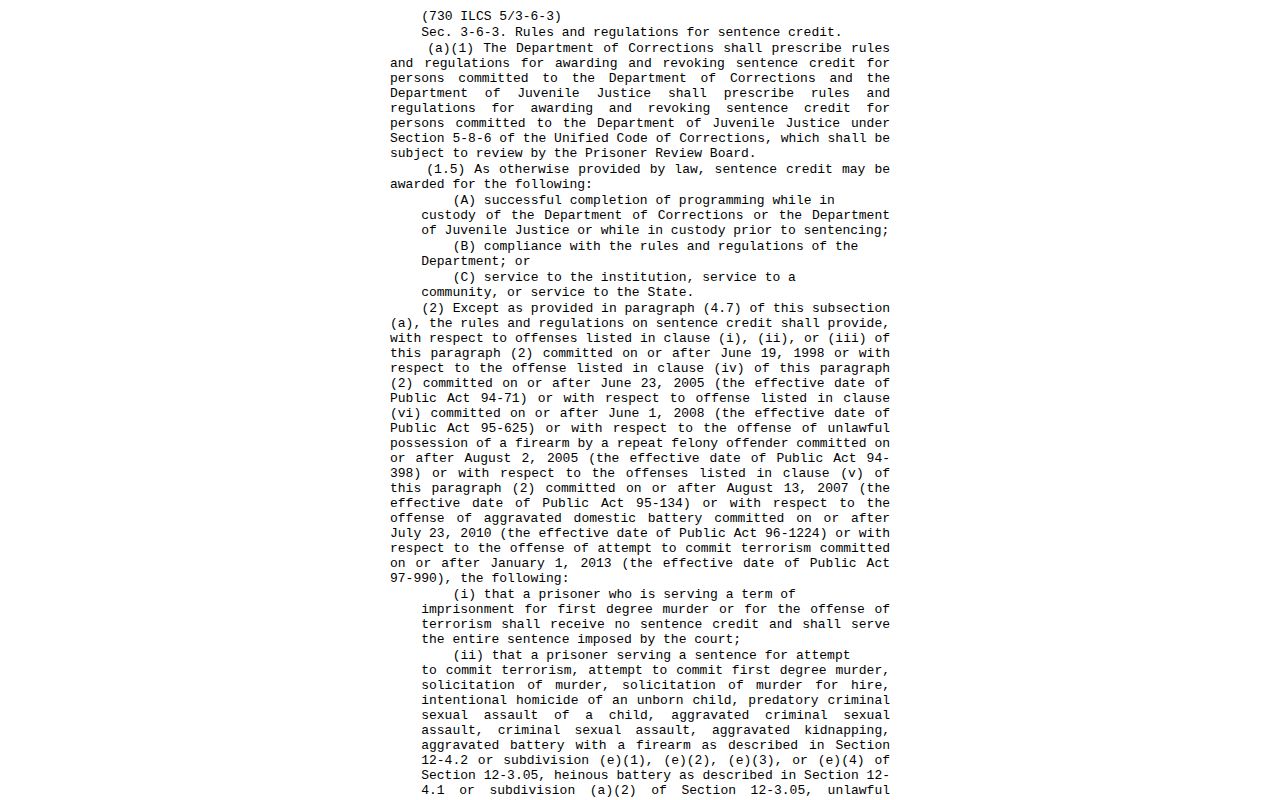
Apply the current law to the actual judgment rather than using a simple percentage calculator.
Why Lake County Release Dates Change
A date can move forward, move back, or stop describing the most likely outcome. The source record should identify the reason when it can. Do not calculate a new date from a rumor about credit, discipline, or a hold.
| Factor | Possible effect | Record to check |
|---|---|---|
| Sentence credit award | May move an eligible projected parole date earlier | IDOC profile and credit record |
| Credit loss or discipline | May move the working date later | IDOC disciplinary and sentence record |
| Amended judgment or custody credit | Changes the legal inputs | Court order and corrected agency calculation |
| Concurrent or consecutive terms | Changes how multiple terms combine | Judgment, mittimus, and IDOC calculation |
| Detainer or warrant | May cause transfer instead of community release | Custody transaction and holding agency record |
| Parole or revocation action | May alter release or return-to-custody status | IDOC and applicable PRB result |
| Release-plan change | May affect implementation even when time is calculated | IDOC release and parole records |
Lake County adds local transfer risks. Temporary McHenry County housing can make a person seem absent from the county portal. The jail dashboard also identifies BOP-contract holds. In both cases, call the location line at 847-377-4107 and identify the legal custodian before interpreting a missing roster entry or passed date.
A parole hearing can affect some cases, but it is not a universal path. Modern determinate-sentence prisoners generally leave prison when statutory sentence time is met, with the Prisoner Review Board setting MSR conditions. Older indeterminate or C-number cases can return for discretionary review. Youthful-parole eligibility also depends on the offense, age, sentence date, and statutory exclusions. Use the current PRB agenda and an actual decision only when that framework applies.
Confirm Lake County Release Dates
When the projected date arrives, run a fresh status check. If IDOC still displays the person, record the current institution or parole/MSR status and see whether the date changed. If the profile disappears, determine whether the sentence may be fully complete. IDOC’s FAQ says completed sentences leave the live public search, so use its Contact Us Record Search with full identifying and incarceration details.
For a Lake County jail sentence, request the Sheriff’s final custody transaction. Ask for actual release or transfer date and time, disposition code, and destination or receiving agency when recorded and disclosable. Reconcile that event with the sentencing order, mittimus, custody-credit order, and any amended judgment. A blank roster result cannot replace those records.
A Lake County VINELink check can provide a pending status-change alert for a matched participating record. Treat the alert as a prompt. Confirm the exact event with the reporting agency and the legal cause with the court.
Note: Phrase the result narrowly, such as “IDOC reports parole” or “the Sheriff recorded transfer to IDOC.”
Lake County Sentence Date Limits
The Lake County jail page says a county-jail sentence may not exceed 364 days. That limit does not produce an individual release date. The county publishes no online good-time calculator and no weekend-release policy in the sources reviewed. Multiple cases, a new warrant, a detainer, periodic imprisonment, or electronic monitoring can change what the end of the jail term means.
Use the mittimus, sentencing order, custody-credit orders, and Sheriff transaction for a county term. A mittimus is the court document that commits a person to custody. Presentence credit may reduce time remaining, while an amended order can change the inputs after sentencing. The Sheriff record then shows whether the person left for the community or moved to another authority.
IDOC’s statewide credit rules should be used only when IDOC governs the prison sentence. A Lake County resident can serve that term anywhere in Illinois because no IDOC prison was identified within the county. The place of conviction and the place of confinement are not the same as the agency that computes release.
Periodic imprisonment and electronic home monitoring add a local status layer. The Lake County Community Based Corrections Center processes and monitors those programs as well as pretrial bond supervision. A person may be outside a jail housing unit and still subject to an active order. The court file and CBCC status should show whether the change is a release from physical housing, a supervised placement, or the end of the term.
Federal custody uses another date source. If a federal defendant was held at Lake County jail under the BOP contract category, the Sheriff transaction can show when the person left that building. It cannot establish the later end of federal custody. The BOP locator and federal docket govern that question. A past BOP release date with no facility means the person left BOP custody on that date, not that every supervised-release term or other hold ended.
After any projected date, compare the current status with the older capture. If IDOC moved the date, retain the new exact label. If the Sheriff recorded transfer, name the receiving agency. If the court amended the judgment, use the amended order as the new legal input. These source-specific statements are more accurate than trying to announce a single universal “out date.”
A records request should seek existing documents, not ask staff to calculate a new sentence. For Lake County, request the booking sheet, custody history, actual release or transfer transaction, disposition code, and receiving agency when recorded and disclosable. Pair those records with the sentencing judgment and credit orders. For IDOC, ask for the docket or release card fields, actual release record, and final discharge information that apply to the person.
Dates also have distinct meanings. The projected minimum or parole date may point to the earliest expected prison release under current inputs. The mandatory outdate is a different internal field. A projected discharge date concerns the later end of legal custody. Writing the full label next to each date prevents a prison-release estimate from being confused with the end of parole or MSR.