
Lake County Parole or Probation
Parole and probation begin through different legal paths. In Illinois, parole or mandatory supervised release, often called MSR, follows an IDOC prison term. The Illinois Prisoner Review Board sets or reviews conditions in matters within its authority, while the IDOC Parole Division supervises people in the community. Probation comes from a criminal court judgment. A Lake County probation case is therefore traced through the Circuit Clerk and Lake County Adult Probation or Court Services, not through a Prisoner Review Board parole search.
The distinction matters when a person has more than one case. Someone may leave the Lake County jail on probation without ever entering IDOC. Another person may transfer from the jail to an IDOC prison, later leave prison on MSR, and still have a separate Lake County court matter. One state result cannot prove that every local obligation ended.
| Supervision | Legal source | Best verification route |
|---|---|---|
| Parole or MSR | Release from an IDOC prison term | IDOC person search, Parole Division, and applicable PRB records |
| Probation | Lake County court sentence or order | Circuit Clerk judgment and Adult Probation or Court Services |
| Electronic monitoring | Court order and CBCC program record | Circuit Clerk order and Community Based Corrections Center |
| Final discharge | Completion or formal end of supervision | IDOC Record Search, PRB action when applicable, or court order |
- MSR
- Mandatory supervised release, a period of state supervision after prison.
- Absconder
- A supervised person reported as having stopped contact or left supervision without authorization.
- Discharge
- The formal end of the custody or supervision term, not just the day prison housing ends.
- Detainer
- A request or hold from another authority that may affect release or transfer.
Verify Lake County Post-Release Supervision
Start with the agency that imposed or now manages the supervision. The IDOC Individual in Custody Search covers people in an Illinois prison and those still shown on parole or MSR. It does not establish county probation. A fully discharged person may no longer appear because IDOC says its live public search displays people who are incarcerated or on parole.
- Identify the custody path. Determine whether the person left Lake County jail under a local court order or entered IDOC on a prison commitment.
- Check the state profile. Search IDOC by IDOC number, partial last name, or date of birth. Compare the identity, offense, and institution or parole information.
- Read the exact status. Treat parole or MSR as active state supervision. Do not turn a projected date into an actual discharge.
- Check the court record. For probation, obtain the judgment, probation order, revocation order, or final disposition from the Lake County Circuit Clerk.
- Confirm with the responsible office. Ask IDOC Parole about state supervision or Adult Probation and Court Services about a Lake County probation order.
- Use an archive when needed. If a completed IDOC sentence no longer appears, use the IDOC Contact Us form and select “Record Search.”
A Sheriff roster result answers current jail custody, not post-release supervision. If the person vanished from the Lake County roster, first rule out transfer to IDOC, temporary housing in McHenry County, federal custody, or another authority. The broader Lake County released-inmate search path explains how the sheriff transaction and court order resolve that first change.
Note: A missing live profile is not proof that parole, probation, or every other legal condition has ended.
Lake County Supervision Record Offices
State parole and local probation records come from different offices. The IDOC Parole Division describes state field supervision. The Illinois Prisoner Review Board publishes hearing and decision material for matters within its jurisdiction. Lake County probation remains tied to the local court file and Court Services.
Illinois Department of Corrections
1000 East Converse Avenue
P.O. Box 19277
Springfield, IL 62794-9277
217-558-2200
Illinois Prisoner Review Board
1001 North Walnut Street
Springfield, IL 62702
217-782-7273
prb.operations@illinois.gov
Lake County Circuit Clerk
Record Searches and file or document requests
The Circuit Clerk asks for a name, years, case type, date of birth for a person, and a self-addressed stamped envelope for a mail search. A document request uses the case number plus requester contact details. The probation order, any later revocation order, and the final disposition give firmer proof than a general status label.
Lake County Supervision Violations
Conditions vary by the controlling order. They can require contact with an officer, approved residence or travel, program participation, or compliance with electronic monitoring. A violation allegation does not by itself show the final result. The supervising agency and the court or Board record must show whether supervision resumed, conditions changed, or custody was revoked.
IDOC maintains an official wanted fugitives page. An absconder listing means IDOC reports a failure to remain under supervision and may show warrant-related information. It is not a new conviction. Check identity carefully, then seek the later agency or hearing record rather than assuming the listing is still current.
The Prisoner Review Board posts revocation hearing results. Outcomes can include no violation and resumed release, a violation with return under conditions, or revocation with a recalculation. The result language controls. VINELink may send a custody-change notice, but it is not a certified ruling on a supervision violation.
Hearing records also need care. The PRB publishes an annual en banc schedule, current agendas and results, a past-parole registry, and monthly revocation material. A calendar proves that a matter was set, not how the Board ruled. Modern determinate-sentence cases generally reach release through statutory sentence computation while PRB sets MSR conditions. Older indeterminate or C-number cases can follow a different discretionary parole process. Youthful-parole review has its own offense, age, sentence-date, and exclusion rules. The individual judgment and the Board’s actual result must guide the reading.
The official revocation-result source shows how state supervision decisions are reported:
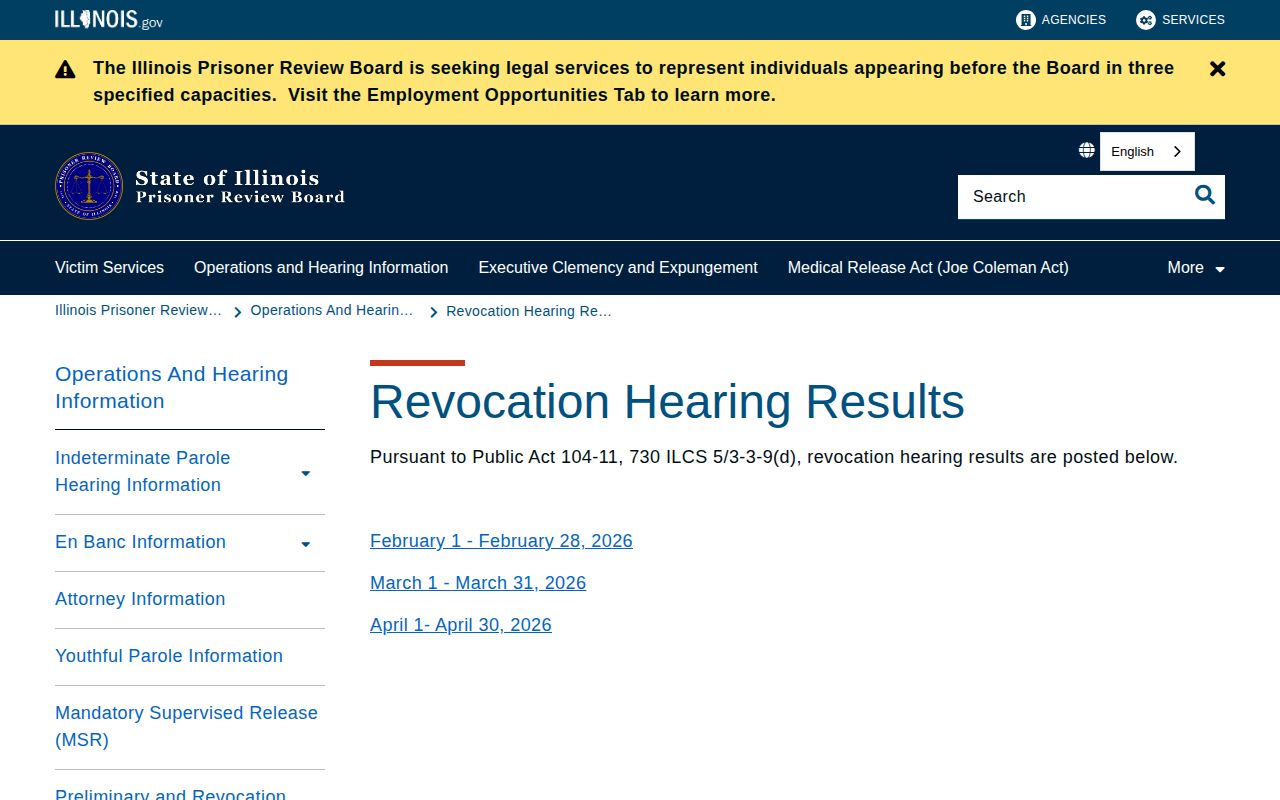
Use the named result and date, then confirm the person’s present status through IDOC.
Lake County Supervision Discharge
Leaving prison starts a new stage when parole or MSR applies. It does not end IDOC legal custody. The state profile may continue to display parole information until the sentence and supervision term are complete. A projected discharge date is an estimate of that later endpoint, while a release date can mark the earlier move from prison into the community.
The Prisoner Review Board has an early final discharge process for eligible cases. A final-discharge action is stronger evidence that state supervision ended than the prison release date. Once IDOC removes a fully completed sentence from the public search, request the archived record through the IDOC Contact Us Record Search route. Include full name, date of birth, year received, known facility, county of conviction, and approximate dates.
County probation ends through the court process. Seek the final order or docket entry from Lake County rather than using a PRB calendar. Electronic monitoring or periodic imprisonment also ends according to its court and CBCC record. Each channel proves only the authority it controls.
Note: Prison release, the end of county monitoring, and final discharge can occur on three different dates.
Lake County Reentry and Supervision
Lake County starts release planning before a person leaves the Adult Corrections Facility. The Sheriff’s reentry program says specialists assess needs at intake and coordinate social-service, behavioral, and educational support. An archived Community Bridge announcement described up to thirty days of continuity after release for participants. Because that description is historic, current availability should be confirmed with the Sheriff rather than assumed.
The local custody map adds an important distinction. The Community Based Corrections Center manages electronic home monitoring, periodic imprisonment, and pretrial bond supervision. A person can be back in the community but still subject to a court order and a structured program. That move is not the same as completing probation, parole, MSR, or the whole sentence.
Reentry support and legal supervision may run side by side, but they answer different questions. A program contact can help with continuity of care. Only the court, IDOC, PRB, or CBCC record can establish the legal status and end date. Ask which program or order applies before treating “released” as “finally discharged.”
A move from the main jail to CBCC may mean electronic monitoring, periodic imprisonment, or pretrial bond supervision. It can alter where a person reports without ending the court’s control. The CBCC contact number is 847-377-4062. Verify the program status there, then use the Circuit Clerk order to learn why it applies and whether a termination order was entered.
County and state records can overlap. If a Lake County case resulted in an IDOC term, the county mittimus establishes the commitment and IDOC records establish prison release, parole or MSR, and final state discharge. If the same person also has probation in another Lake County matter, neither record should be read as ending the other. Record each case number, agency, and status separately.