
Lake County CBCC Status Paths
The Community Based Corrections Center is not another name for the Lake County Jail. It processes, detains, and monitors people under several court-directed arrangements. Electronic home monitoring allows a person to live outside a jail housing unit while remaining subject to location rules and program oversight. Periodic imprisonment can alternate time in custody with scheduled time in the community. Pretrial bond supervision follows a court order while the criminal case remains open.
Because those paths differ, “back home” does not necessarily mean “finally discharged.” A move from the Adult Corrections Facility to CBCC or electronic monitoring is a change in custody or supervision. Completion occurs when the controlling court and program records show that the relevant status ended. A later probation, jail, state-prison, or other order may also affect the person. Preserve the exact wording used by CBCC and the court rather than translating every change into release.
The records should answer separate questions. The Sheriff's transaction can show departure from jail housing. CBCC can confirm the monitoring or periodic-imprisonment status it administers. The Circuit Clerk file supplies the order, modification, violation action, or termination. Together, those sources distinguish a housing change from the end of all Lake County correctional control.
Confirm Lake County CBCC Release
Call CBCC at 847-377-4062 and ask which status the office can confirm. Use the person's full name and case number when available. Avoid asking staff to interpret the legal effect of an order. The precise request is whether CBCC records show active monitoring, a periodic-imprisonment schedule, pretrial supervision, a transfer, or a termination date.
- Check the official CBCC page to confirm the program and contact route.
- Call CBCC for the current program status that its staff can disclose.
- Use the Circuit Clerk case file to obtain the order that created, changed, or ended the status.
- If the person came from the county jail, obtain the Sheriff's custody transaction to document that physical move.
- If a later order sent the person to jail or IDOC, follow the locator and records process for that custodian.
The Lake County released inmate search guide provides the broader custody-class workflow. The Sheriff current roster is helpful only when jail custody is the question. It is not a complete CBCC history. VINELink may report a custody event when the matching result names the participating agency, but it does not certify the end of home monitoring, periodic imprisonment, or a court case.
Lake County CBCC Contact
Lake County Community Based Corrections Center is at 15 South Martin Luther King Jr. Avenue, Waukegan, IL 60085. Its phone number is 847-377-4062. The available county research does not publish a distinct CBCC public-counter schedule, so call before planning an in-person visit. For court orders, use the Circuit Clerk rather than treating CBCC as the court record office.
15 South Martin Luther King Jr. Avenue
Waukegan, IL 60085
847-377-4062
When an exact program record is needed, describe the event and time range narrowly. Ask for the enrollment or placement status, monitoring or periodic-imprisonment record, status change, completion or termination date, and transfer information if recorded and disclosable. A request should seek existing records, not ask the agency to create a legal conclusion. Lake County's FOIA hub routes requests to the department that maintains them.
For the controlling judicial record, the Lake County Circuit Clerk's search process uses the person's name, relevant years, case type, date of birth, and a self-addressed stamped envelope for mail. A document request needs the case number and requester contact details. Useful records can include the pretrial-release or bond order, periodic-imprisonment sentence, electronic-monitoring terms, modification, revocation order, and final disposition.
Lake County CBCC Functions
CBCC is a Sheriff's Office community-corrections and monitoring unit. Its role is distinct from ordinary jail housing. Electronic home monitoring checks compliance with a court or program placement while the person resides in the community. Periodic imprisonment is a sentence structure in which custody occurs during set periods rather than as one uninterrupted stay. Pretrial bond supervision monitors conditions before the case reaches final disposition.
These functions can overlap with records held elsewhere. The Adult Corrections Facility maintains the jail booking and custody transaction. CBCC maintains records tied to the program it operates. The Circuit Clerk maintains the orders and docket. Adult Probation is a separate office for court-ordered probation. IDOC and the Illinois Prisoner Review Board handle state-prison parole or mandatory supervised release, not ordinary CBCC pretrial monitoring.
Agency names matter in a status check. A CBCC record cannot establish the end of an unrelated jail hold, state sentence, or federal matter. In the same way, an IDOC profile does not describe a Lake County periodic-imprisonment schedule. Follow each active matter to the office that created it, then compare dates before drawing a conclusion.
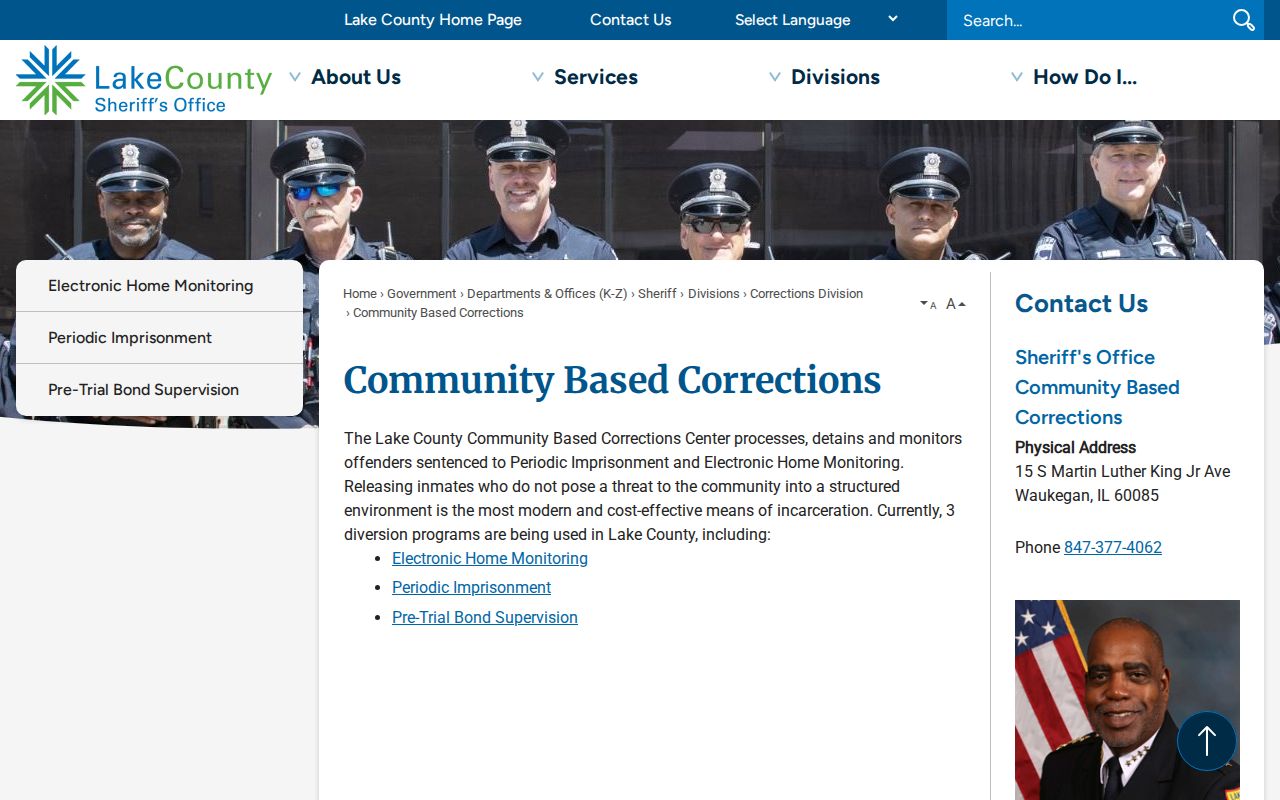
The county's Community Based Corrections page shows why facility type matters.
Lake County Electronic Monitoring
A person on electronic home monitoring may have physically left the jail while remaining under a live restriction. This is why a location change and a discharge date must be verified separately. The placement order should identify the authority for monitoring. CBCC confirms the operational status, while the docket can show later amendments, alleged violations, or termination.
Do not use an absent jail-roster result as proof that monitoring ended. The Tyler portal labels its results as current inmates, and a community placement may fall outside what that display conveys. There is also no official Lake County rolling release archive that captures every move into or out of CBCC. Direct confirmation is the stronger route.
If a person is returned to the Adult Corrections Facility, search the current roster and call Corrections. If a judge instead modifies conditions while the person remains outside jail, use the new order. A program change can occur without a final case disposition, and a case disposition can impose probation or another obligation after CBCC involvement ends.
Lake County Periodic Imprisonment
Periodic imprisonment does not follow a simple in-or-out model. A person can report for scheduled custody and return to the community between required periods. One departure from CBCC therefore may be part of an ongoing sentence rather than its completion. The sentence order and CBCC schedule establish the structure. The final record should show when all required periods and any related conditions ended.
When verifying a specific event, ask whether the date was a scheduled community interval, a status modification, a transfer, or final completion. Those terms prevent an ordinary scheduled departure from being mislabeled as a final release. If a violation leads to a new court action, the docket and resulting custody record will document the next status.
Exact timestamps may be spread across more than one source. CBCC has the program event; the court has the legal authority; the jail has any new booking or release transaction. A date-bounded request is more useful than a demand for every record. Include the case number and known schedule so the office can identify the right event.
Lake County Pretrial Supervision
CBCC also supports pretrial bond supervision. “Pretrial” means the case has not reached final disposition. Release from jail under those terms is not a dismissal or acquittal, and supervision outside the facility is not a sentence-completion record. The current order defines the conditions, while later docket entries can change or end them.
The Sheriff jail transaction can confirm when the person left a housing unit. It cannot by itself show that every pretrial condition later ended. Use the Circuit Clerk's document request route for a copy of the relevant order. Pair that document with CBCC confirmation when the monitoring status is important.
Lake County jail reentry specialists begin assessment and planning at intake, and older county material described short-term service continuity for some Community Bridge participants after release. That archived program detail should be verified before relying on current availability. It also concerns support services, not proof that CBCC or court supervision terminated.